A 10,000 mAh power bank will not charge a 4,000 mAh phone three times, even though the maths looks obvious. The figure on the box describes the internal cells, not the energy that reaches your phone. This guide shows how to read the label, estimate the number of charges, pick the right output power and fly with a power bank.
mAh at 3.7 V: what the label really says
The lithium cells inside a power bank run at about 3.6 or 3.7 V, and the mAh rating is measured at that voltage. The USB port, however, delivers at least 5 V, and 9, 12 or 20 V when fast charging. The circuit that steps the voltage up uses some of the energy and loses some as heat.
To compare two models, convert to watt-hours (Wh), the unit of real energy:
- Wh = mAh × V ÷ 1000
- 10,000 mAh × 3.7 V = 37 Wh
- 20,000 mAh × 3.7 V = 74 Wh
Some labels also print a rated capacity at 5 V, much lower than the big number on the box. That is the more honest of the two figures, because it accounts for the conversion.
How many phone charges to expect
Between conversion losses, heat, the cable and the phone’s own charging circuit, usually 60 to 70% of the nominal energy ends up in the phone battery. Do the sum in Wh, since the phone battery also runs at around 3.8 V.
- Power bank energy: 10,000 mAh × 3.7 V = 37 Wh.
- Usable energy at 65% efficiency: 37 × 0.65 ≈ 24 Wh.
- Phone battery: 4,000 mAh × 3.85 V ≈ 15.4 Wh.
- Number of charges: 24 ÷ 15.4 ≈ 1.5 full charges.
Shortcut when both voltages are close: power bank capacity × 0.65 ÷ phone capacity. A 20,000 mAh unit therefore gives about 3 charges of a 4,000 mAh phone and 2.5 charges of a 5,000 mAh phone. An 8,000 mAh tablet barely fills one and a half times.
Your phone’s capacity is on its spec sheet. Using the phone while it charges, or charging wirelessly, lowers the result.
Output power: watts, USB PD and Quick Charge
Power in watts is W = V × A. A basic 5 V, 2 A USB port gives 10 W. To charge faster, the power bank and the phone agree on a higher voltage through a shared protocol.
- USB Power Delivery (PD) runs over USB-C. It is the standard for recent iPhones, many Android phones, tablets and laptops. 20 W over PD is enough to fast-charge an iPhone.
- Quick Charge (QC) is Qualcomm’s protocol, often found on the USB-A port. QC 3.0 reaches 18 W on compatible phones.
If the two devices do not speak the same protocol, charging falls back to plain 5 V, which is slower. So check the protocol of each port, not just the headline wattage. The Oryx NP-21N 20000 mAh power bank states it clearly: USB-C with Power Delivery 20 W and USB-A with Quick Charge 3.0 18 W, charging two devices at once.
With two devices plugged in, the total power is split between the ports. The advertised maximum usually applies to a single port in use.
Charging a laptop over USB-C
It works under three conditions. The laptop must accept charging over USB-C (a port marked PD or with a battery symbol). The power bank must deliver enough PD power, in practice 45 W for an ultrabook and 65 W or more for a hungrier model. The cable must keep up: above 60 W you need a USB-C cable rated for 5 A.
With a 20 W output, a laptop charges very slowly, only while switched off, or not at all. On energy, a laptop battery is often 50 Wh or more, while a 20,000 mAh power bank holds 74 Wh before losses: expect one recharge at best.
The models in stock in our power bank range top out at 22.5 W. They are for phones, tablets, earbuds and small USB accessories, not laptops.
10,000 or 20,000 mAh: comparison
| Criterion | 10,000 mAh | 20,000 mAh | Magnetic 10,000 mAh |
|---|---|---|---|
| Nominal energy | 37 Wh | 74 Wh | 37 Wh |
| Charges of a 4,000 mAh phone | about 1.5 | about 3 | about 1 wireless, more by cable |
| Weight and size | fits in a pocket | roughly twice as heavy | stays on the back of the phone |
| Plane (cabin) | allowed | allowed | allowed |
| Use | a day in town | weekend, travel, several devices | phone in use while charging |
For a working or school day, 10,000 mAh power banks are enough. For a trip or a weekend away from sockets, 20,000 mAh power banks save you from watching the percentage.
Magnetic power banks: handy, but less efficient
A magnetic power bank snaps onto the back of the phone and charges it by induction, with no cable. It works with MagSafe-compatible iPhones and Qi2 phones. Other wireless-charging phones need a magnetic case or ring.
Induction loses more energy than a cable and runs warmer, so you get fewer charges for the same capacity. The Xiaomi 10000 mAh magnetic power bank with built-in stand also has wired USB charging, useful when the level drops, and its stand holds the phone in portrait or landscape for a video. The full range is on the magnetic power bank page.
Flying: the 100 Wh rule
The IATA rules, applied by most airlines, are:
- Power banks go in the cabin only, never in checked baggage.
- Up to 100 Wh: allowed without approval. A 20,000 mAh unit (74 Wh) is fine.
- 100 to 160 Wh: airline approval required, two batteries at most.
- Above 160 Wh: not allowed.
If the Wh figure is not printed, work it out (mAh × 3.7 ÷ 1000) and keep the label readable for security. Several airlines now ban using or recharging a power bank during the flight: read your airline’s conditions before you travel.
Safety: what to check
- Overcharge, overheating and short-circuit protection, listed on the product sheet.
- Never leave a power bank in direct sun or in a closed car in summer. Heat damages lithium cells.
- Do not charge it under a pillow or on a bed, where heat cannot escape.
- A battery that is swollen, deformed, unusually hot or smells burnt must not be charged again: unplug it and take it to a collection point.
- A power bank stored for months keeps better at around half charge. Top it up from time to time.
Our advice by use
- One phone, one day: a compact 10,000 mAh unit such as the Oryx NP-11N 10000 mAh.
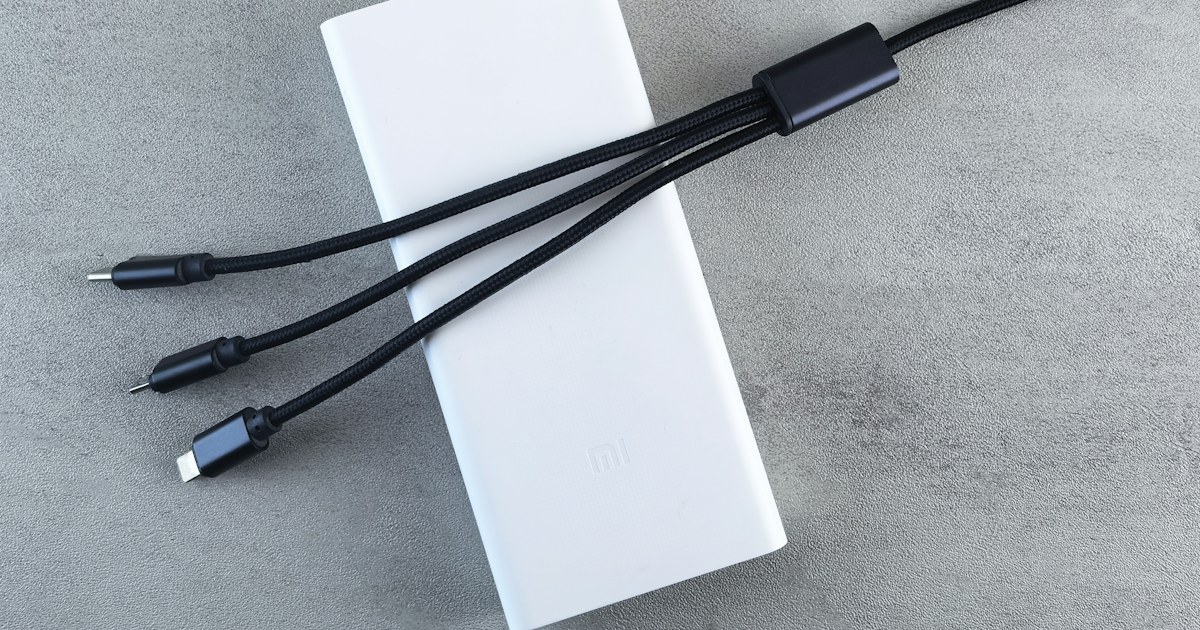
- No more cables to carry: the Amaya 10000 mAh power bank with 4 built-in cables (iPhone, Type C, Micro USB and USB) or the Xiaomi 20000 mAh 22.5 W with built-in cable.
- Fast charging a recent iPhone or Android: a USB-C Power Delivery output of at least 20 W, as on the Oryx NP-21N.
- Camping, hiking, power cuts: the Plustar PW100S 10,000 mAh solar charger charges from the mains or from its folding panels. Solar stays slow: fill it from a socket before you leave and keep the panels as a backup.
- Laptop: look for a PD power bank of 45 W or more, and a laptop that accepts USB-C charging.


